" height="133.020195px" id="Pmb3oQVE6" transform="translate(155.31 0.8)" width="88.57999999999998px"/><path d="M 47.61 106.14 C 31.72 106.14 19.64 100.82 11.7 90.34 C 3.93 80.02 0 67.49 0 53.1 C 0 38.71 3.94 26.46 11.69 16 C 19.6 5.38 31.69 0 47.61 0 C 63.53 0 75.63 5.38 83.57 15.99 C 91.32 26.47 95.25 38.95 95.25 53.11 C 95.25 67.27 91.32 80.02 83.57 90.35 C 75.59 100.84 63.49 106.15 47.61 106.15 Z M 47.61 4.48 C 33.18 4.48 22.31 9.25 15.28 18.67 C 8.11 28.34 4.48 39.93 4.48 53.1 C 4.48 66.27 8.11 78.12 15.27 87.64 C 22.31 96.93 33.19 101.65 47.6 101.65 C 62.01 101.65 72.81 97.06 79.99 87.62 C 87.13 78.1 90.76 66.49 90.76 53.09 C 90.76 39.69 87.13 28.33 79.97 18.65 C 72.82 9.11 62.24 4.47 47.6 4.47 Z M 47.56 85.22 C 40.02 85.22 34.12 82.29 30.02 76.49 C 26.12 70.96 24.13 63.1 24.13 53.1 C 24.13 43.1 26.11 35.22 30.02 29.74 C 34.14 23.98 40.04 21.06 47.56 21.06 C 55.08 21.06 60.96 23.98 65.02 29.75 C 68.91 35.2 70.89 43.06 70.89 53.1 C 70.89 63.14 68.92 70.99 65.02 76.49 C 60.98 82.28 55.11 85.22 47.56 85.22 Z M 47.56 25.54 C 41.49 25.54 36.95 27.77 33.67 32.35 C 30.31 37.06 28.61 44.04 28.61 53.11 C 28.61 62.18 30.31 69.16 33.67 73.91 C 36.93 78.51 41.47 80.75 47.55 80.75 C 53.63 80.75 58.14 78.52 61.34 73.93 C 64.7 69.19 66.39 62.19 66.39 53.11 C 66.39 44.03 64.7 37.04 61.36 32.35 C 58.13 27.77 53.62 25.55 47.56 25.55 Z" fill="rgb(77, 78, 83)" height="106.15039999999999px" id="ER7nj0uz3" transform="translate(251.4 32.33)" width="95.24999999999997px"/><path d="M 88.87 102.13 L 59.34 102.13 L 59.34 41.89 C 59.34 37.25 58.76 33.69 57.6 31.3 C 55.6 27.2 51.8 25.21 45.99 25.21 C 38.7 25.21 33.83 28.29 31.12 34.63 C 29.67 38.06 28.93 42.66 28.93 48.28 L 28.93 102.14 L 0 102.14 L 0 2.46 L 28.14 2.46 L 28.14 11.59 C 29.97 9.3 31.72 7.53 33.44 6.23 C 38.8 2.1 45.67 0 53.82 0 C 63.93 0 72.36 2.78 78.89 8.26 C 85.51 13.87 88.86 23.09 88.86 35.67 L 88.86 102.12 Z M 63.83 97.65 L 84.38 97.65 L 84.38 35.68 C 84.38 24.48 81.56 16.4 76.01 11.69 C 70.32 6.91 62.86 4.48 53.83 4.48 C 46.69 4.48 40.74 6.27 36.17 9.79 C 33.66 11.7 30.84 15.07 27.79 19.83 L 23.66 26.26 L 23.66 6.94 L 4.49 6.94 L 4.49 97.65 L 24.44 97.65 L 24.44 48.28 C 24.44 41.97 25.28 36.93 26.99 32.88 C 30.44 24.82 36.82 20.74 45.98 20.74 C 53.57 20.74 58.83 23.64 61.62 29.34 C 63.09 32.4 63.82 36.5 63.82 41.89 L 63.82 97.65 Z" fill="rgb(77, 78, 83)" height="102.1403px" id="F7RAtrgvn" transform="translate(365.92 31.68)" width="88.87px"/><path d="M 0 44.37 L 0 26.61 L 13.02 26.61 L 13.02 0 L 37.22 0 L 37.22 26.61 L 52.39 26.61 L 52.39 44.37 L 37.22 44.37 L 37.22 94.78 C 37.22 98.68 37.71 101.12 38.67 102.07 C 39.67 103.05 42.62 103.52 47.58 103.52 C 48.34 103.52 49.11 103.48 49.94 103.47 C 50.78 103.46 51.6 103.42 52.39 103.33 L 52.39 121.97 L 40.83 122.43 C 29.26 122.82 21.38 120.8 17.14 116.29 C 14.4 113.43 13.02 109.04 13.02 103.08 L 13.02 44.37 Z" fill="rgb(77, 78, 83)" height="122.47729173181735px" id="F_GEdFCRb" transform="translate(473.46 10.48)" width="52.39000000000004px"/><path d="M 68.25 4.49 C 74.77 7.48 80.17 12.17 84.42 18.59 C 88.23 24.25 90.72 30.82 91.85 38.29 C 92.5 42.68 92.75 48.98 92.66 57.24 L 24.58 57.24 C 24.96 66.78 28.22 73.5 34.37 77.35 C 38.09 79.73 42.59 80.94 47.84 80.94 C 53.39 80.94 57.93 79.5 61.41 76.57 C 63.31 75.01 64.96 72.79 66.42 69.99 L 91.39 69.99 C 90.73 75.66 87.7 81.42 82.32 87.24 C 73.95 96.51 62.24 101.14 47.16 101.14 C 34.72 101.14 23.74 97.23 14.25 89.42 C 4.72 81.62 0 68.88 0 51.25 C 0 34.73 4.27 22.04 12.87 13.23 C 21.44 4.41 32.58 0 46.28 0 C 54.43 0 61.73 1.51 68.26 4.49 M 31.68 26.02 C 28.21 29.66 26.08 34.58 25.17 40.79 L 67.27 40.79 C 66.83 34.17 64.65 29.14 60.75 25.71 C 56.86 22.28 52.05 20.58 46.26 20.58 C 40 20.58 35.15 22.38 31.68 26.02 Z" fill="rgb(77, 78, 83)" height="101.14030000000001px" id="jlEGzBEnJ" transform="translate(545.43 33.66)" width="92.67773092046734px"/><path d="M 0 0 L 24 0 L 24 69.59 L 54.85 33.6 L 85.22 33.6 L 51.73 69.14 L 86.54 128.54 L 56.77 128.54 L 34.12 87.79 L 24 98.54 L 24 128.54 L 0 128.54 Z" fill="rgb(77, 78, 83)" height="128.53996px" id="ZuKYrOx4n" transform="translate(661.04 3.04)" width="86.54000000000008px"/><path d="M 77.47 46.46 L 77.47 41 L 134.48 41 L 134.48 0 L 0 0 L 0 134.45 L 134.48 134.45 L 134.48 98.11 L 77.47 98.11 L 77.47 92.64 L 134.48 92.64 L 134.48 85.2 L 77.47 85.2 L 77.47 79.74 L 134.48 79.74 L 134.48 72.28 L 77.47 72.28 L 77.47 66.83 L 134.48 66.83 L 134.48 59.37 L 77.47 59.37 L 77.47 53.91 L 134.48 53.91 L 134.48 46.46 Z" fill="rgb(231, 0, 51)" height="134.45px" id="GmrYTTGI7" width="134.48px"/></g></svg>)
Case study
UNC-CH School of Education: Dynamic HyFlex Classrooms
Case study
UNC-CH School of Education: Dynamic HyFlex Classrooms
Case study
UNC-CH School of Education: Dynamic HyFlex Classrooms

The Challenge
The University of North Carolina at Chapel Hill (UNC-CH) School of Education sought to redefine the learning experience for both students and educators. Even before the pandemic necessitated a shift in educational delivery, the school was proactively exploring HyFlex (Hybrid/Flexible) teaching methods.
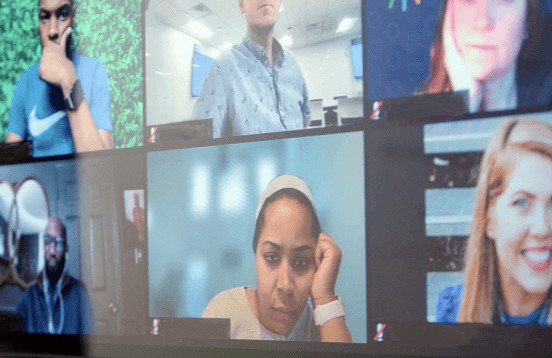
The primary hurdle was engagement: as remote student numbers grew, educators needed a way to interact equitably with both in-person and remote participants. They required a solution that moved beyond traditional hardware to create a truly integrated, interactive environment.
Our Solution
Partnering with KONTEK, the School of Education implemented a custom AV over IP system centered on Extron NAV technology. This system transformed two classrooms into "hyper-connected" hubs.
Key Features:
AV over IP Integration: Unlike older systems requiring bulky equipment racks, this low-profile, lightweight solution is fully scalable. It allows the School of Education to easily expand these capabilities to other rooms or across the entire campus in the future.
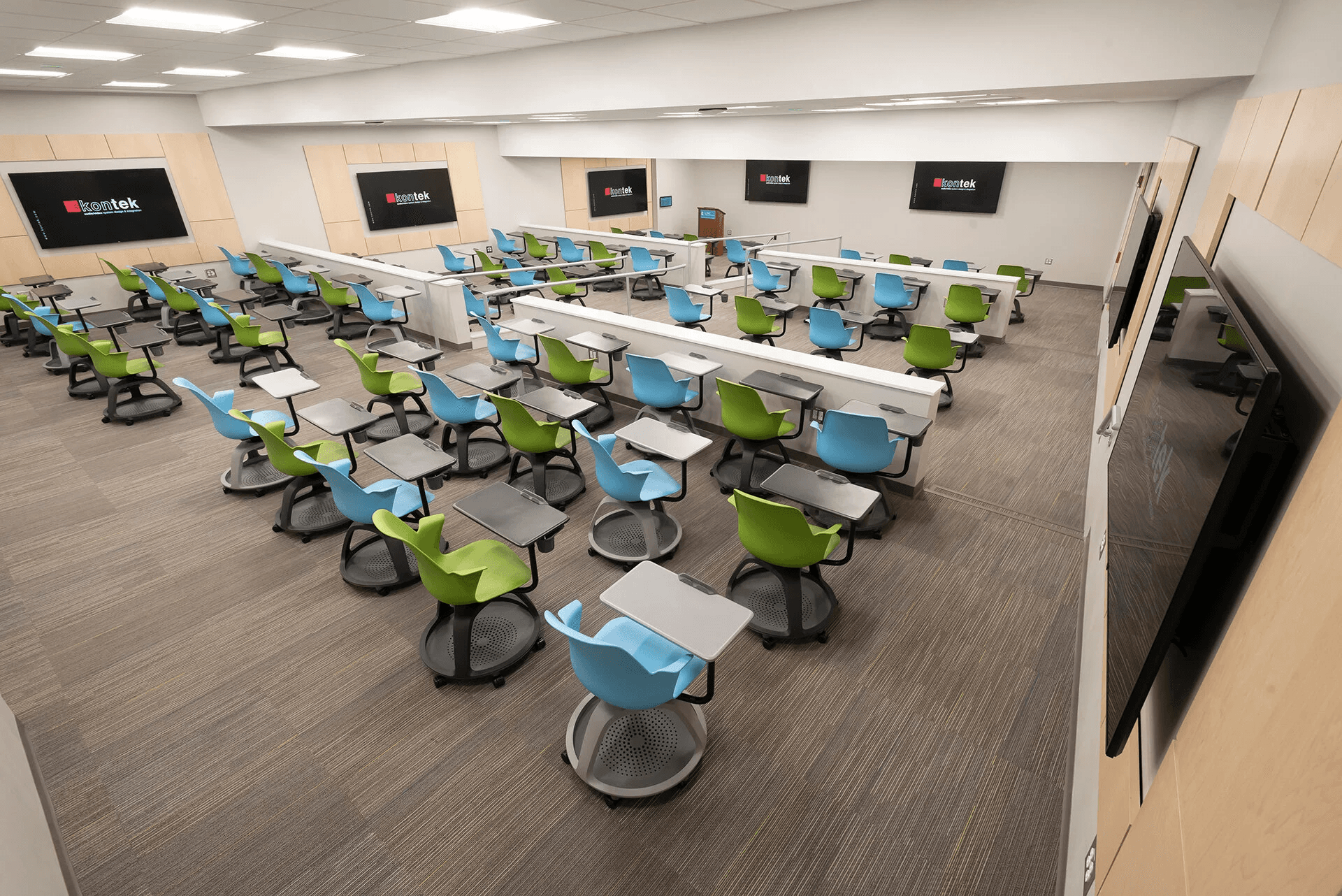
Visual Flexibility: Each room is equipped with four projectors and four displays. Through a user-friendly interface, educators can use presets like:
"Basic" Mode: Mirrors the same source across all screens.
"Dual Content" Mode: Displays different sources on the left and right screens.
Custom Arrangements: Educators have the freedom to route any source to any display, even across different rooms.
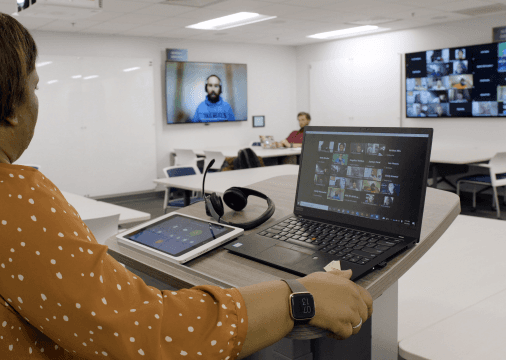
Advanced Remote Engagement: The back-end system allows educators to break students into multiple Zoom Rooms. This enables remote students to see, hear, and interact directly with the educator and their in-person peers.
Seamless Control: Educators use iPad controllers for familiar, portable Zoom Room management. Two additional mounted iPads are dedicated to controlling breakout-capable display areas.
Precision Audio: A "flawless and invisible" audio management system handles the complexity of multiple breakout sessions. Zoned audio automatically tracks the speaker's location and adjusts for individual voice levels to ensure crystal-clear communication.
The Impact
The implementation has provided the School of Education with the most effective teaching tools available, ensuring that the technology serves the pedagogy rather than hindering it.
"The School of Education brought vision to the project, but KONTEK brought their expertise in the technologies available. Things got done the way KONTEK said they would get done."
— Calvin Groves, Director of Information Technology, UNC School of Education
The Challenge
The University of North Carolina at Chapel Hill (UNC-CH) School of Education sought to redefine the learning experience for both students and educators. Even before the pandemic necessitated a shift in educational delivery, the school was proactively exploring HyFlex (Hybrid/Flexible) teaching methods.
The primary hurdle was engagement: as remote student numbers grew, educators needed a way to interact equitably with both in-person and remote participants. They required a solution that moved beyond traditional hardware to create a truly integrated, interactive environment.
Our Solution
Partnering with KONTEK, the School of Education implemented a custom AV over IP system centered on Extron NAV technology. This system transformed two classrooms into "hyper-connected" hubs.
Key Features:
AV over IP Integration: Unlike older systems requiring bulky equipment racks, this low-profile, lightweight solution is fully scalable. It allows the School of Education to easily expand these capabilities to other rooms or across the entire campus in the future.
Visual Flexibility: Each room is equipped with four projectors and four displays. Through a user-friendly interface, educators can use presets like:
"Basic" Mode: Mirrors the same source across all screens.
"Dual Content" Mode: Displays different sources on the left and right screens.
Custom Arrangements: Educators have the freedom to route any source to any display, even across different rooms.
Advanced Remote Engagement: The back-end system allows educators to break students into multiple Zoom Rooms. This enables remote students to see, hear, and interact directly with the educator and their in-person peers.
Seamless Control: Educators use iPad controllers for familiar, portable Zoom Room management. Two additional mounted iPads are dedicated to controlling breakout-capable display areas.
Precision Audio: A "flawless and invisible" audio management system handles the complexity of multiple breakout sessions. Zoned audio automatically tracks the speaker's location and adjusts for individual voice levels to ensure crystal-clear communication.
The Impact
The implementation has provided the School of Education with the most effective teaching tools available, ensuring that the technology serves the pedagogy rather than hindering it.
"The School of Education brought vision to the project, but KONTEK brought their expertise in the technologies available. Things got done the way KONTEK said they would get done."
— Calvin Groves, Director of Information Technology, UNC School of Education
The Challenge
The University of North Carolina at Chapel Hill (UNC-CH) School of Education sought to redefine the learning experience for both students and educators. Even before the pandemic necessitated a shift in educational delivery, the school was proactively exploring HyFlex (Hybrid/Flexible) teaching methods.
The primary hurdle was engagement: as remote student numbers grew, educators needed a way to interact equitably with both in-person and remote participants. They required a solution that moved beyond traditional hardware to create a truly integrated, interactive environment.
Our Solution
Partnering with KONTEK, the School of Education implemented a custom AV over IP system centered on Extron NAV technology. This system transformed two classrooms into "hyper-connected" hubs.
Key Features:
AV over IP Integration: Unlike older systems requiring bulky equipment racks, this low-profile, lightweight solution is fully scalable. It allows the School of Education to easily expand these capabilities to other rooms or across the entire campus in the future.
Visual Flexibility: Each room is equipped with four projectors and four displays. Through a user-friendly interface, educators can use presets like:
"Basic" Mode: Mirrors the same source across all screens.
"Dual Content" Mode: Displays different sources on the left and right screens.
Custom Arrangements: Educators have the freedom to route any source to any display, even across different rooms.
Advanced Remote Engagement: The back-end system allows educators to break students into multiple Zoom Rooms. This enables remote students to see, hear, and interact directly with the educator and their in-person peers.
Seamless Control: Educators use iPad controllers for familiar, portable Zoom Room management. Two additional mounted iPads are dedicated to controlling breakout-capable display areas.
Precision Audio: A "flawless and invisible" audio management system handles the complexity of multiple breakout sessions. Zoned audio automatically tracks the speaker's location and adjusts for individual voice levels to ensure crystal-clear communication.
The Impact
The implementation has provided the School of Education with the most effective teaching tools available, ensuring that the technology serves the pedagogy rather than hindering it.
"The School of Education brought vision to the project, but KONTEK brought their expertise in the technologies available. Things got done the way KONTEK said they would get done."
— Calvin Groves, Director of Information Technology, UNC School of Education
Related
Trusted by innovators who redefine communication







Trusted by innovators who redefine communication
Trusted by innovators who redefine communication
Let’s build your dream AV project together.
Strategic, precise guidance to turn communication goals into systems that perform where it matters most.

Get pro AV insights.
Get pro AV insights.