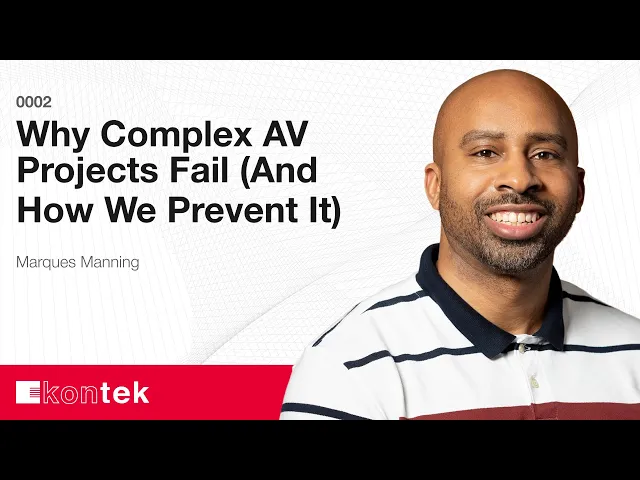
Why Complex AV Projects Fail: The Critical Early Phase That Makes or Breaks Success
The Fatal Flaw is Missing the Human Element
Here's the painful truth about failed AV projects—they rarely fail because of technology. They fail because someone forgot to ask the right questions of the right people at the right time.
Sadly, we've seen this time and time again over the years no matter the industry. You've just completed a stunning new conference space. Construction finished on schedule, the walls look perfect, everything seems ready. Then the actual users walk in on day one and ask, "Where do I plug in my laptop?" Nobody thought to ask whether people would want physical connections at the table. Now you're talking about core drilling floors, running new conduit, and watching your budget escalate by tens of thousands of dollars.
This scenario plays out more often than anyone wants to admit. This happens when you skip what we like to call the "dreaming session"—that critical phase where you gather every stakeholder who will actually use the space and listen intently to how they work, what they need, and what makes their communication successful.
There's a Cost to Moving too Fast
When organizations rush past the discovery phase, problems multiply. What starts as a missed detail about laptop connectivity cascades into infrastructure challenges, budget overruns, construction delays, and ultimately, a space that doesn't serve its purpose.
On the latest episode of our podcast, our President, Marques Manning, shared a story about an 18-month delay on a military project we were eventually brought in on because the previous team delivered as substandard installation that wasn't functional. The financial hit from bringing in another contractor pales next to the hidden costs—lost productivity, damaged stakeholder trust, events held in inadequate spaces, and the grinding frustration of knowing your investment isn't producing any value.
The irony is that organizations often choose the lowest price to save money, then spend exponentially more fixing problems that proper planning would have prevented. Going slow at the beginning creates velocity at the end. It's basic physics and budget working together.
The Five-Phase Protection Against AV Project Failure
We think complex projects succeed when they follow a deliberate process that catches problems before they become expensive surprises.
Phase one demands thorough stakeholder engagement. Bring technology specialists into architectural programming sessions, not after construction documents are finalized. Gather end users, IT teams, facilities managers, executive sponsors—everyone who touches the space. Document not just what they want, but how they actually work. Do they walk in with laptops? Phones? Do they expect host computers already in the room? These details drive everything from floor boxes to conduit routing to electrical circuits.
Phase two translates dreams into technical reality. Expert design teams sketch concepts, identify infrastructure requirements, and reality-check ideas against physics and budget. Can that 20-foot video wall work? Absolutely. But it requires structural support analysis, dedicated electrical circuits, specialized mounting systems, and strategic cable management. All of this needs architectural coordination before construction begins.
Phase three develops comprehensive solutions with no surprises. Detailed technical drawings capture 85-90% of project requirements before installation starts. This precision dramatically reduces the risk of change orders and prevents the dreaded mid-project revelation that something critical was forgotten.
Phase four executes efficiently because the groundwork is solid. Installation teams receive complete packages that tell them exactly what goes where. No guesswork, no improvisation, no overnight parts orders. Projects finish faster than clients expect because all the hard thinking happened upfront.
Phase five ensures ongoing partnership beyond installation. Support teams monitor performance, address issues quickly, and maintain relationships that last 12-15 years or more.
So... Bring Experts In Early
If you're planning a complex AV project—whether a single conference room or an entire campus—make one non-negotiable commitment: bring your technology implementation specialist to the table during architectural programming, not after construction documents are complete.
Have conversations about user workflows, infrastructure requirements, and technical possibilities while you can still influence wall locations, electrical planning, and structural considerations. This single decision prevents more project failures than any other factor.
The price of expertise always costs less than the price of fixing mistakes. Your communication vision deserves technical partners who listen intently, ask questions others don't know to ask, and translate dreams into lasting reality—not vendors racing to the bottom on price while leaving you with rooms that sit vacant for 18 months.
Podcast Chapters
(00:01) The Hidden Risks of Missing Stakeholder Buy-In
(03:46) Designing Around Real User Workflows
(10:51) The Power of a Methodical, Consultative Process
(17:53) Navigating Budget Conversations With Transparency
(24:06) Value Rooted in Expertise and Team Structure
(26:20) Long-Term Costs Versus Upfront Investment
(32:33) Essential Advice for Decision Makers
Related Questions
Why do complex AV projects fail?
Most AV project failures are not caused by technology. They happen because the right stakeholders were not consulted early enough in the process. Skipping the discovery phase means critical details, like whether users need physical laptop connections at a conference table, get overlooked until after construction is complete. What starts as a missed detail can escalate into floor core drilling, new conduit runs, and budget overruns that cost tens of thousands of dollars.
What is a dreaming session in AV project planning?
A dreaming session is the stakeholder discovery phase where every person who will use a space is gathered to discuss how they work, what they need, and what makes their communication successful. KONTEK uses this phase to uncover details that drive infrastructure decisions, including floor box placement, conduit routing, electrical circuits, and equipment selection. Projects that skip this step frequently require expensive corrections after construction is finished.
When should an AV specialist be brought into a building project?
AV technology specialists should be involved during the architectural programming phase, before construction documents are finalized. Early involvement allows the team to influence wall locations, electrical planning, structural considerations, and conduit routing while changes are still low-cost. Bringing in a specialist after construction is complete significantly increases the risk of change orders, delays, and spaces that cannot support the technology the client needs.
What are the five phases of a successful AV project?
KONTEK structures complex AV projects across five phases. Phase one focuses on thorough stakeholder engagement, gathering end users, IT teams, facilities managers, and executives. Phase two translates those goals into technical designs that account for budget and physics. Phase three produces detailed technical drawings that capture 85 to 90 percent of project requirements before installation begins. Phase four executes installation efficiently because all planning is complete. Phase five provides ongoing support and partnership that typically spans 12 to 15 years.
Relevant IndustRIes:
Related Services:


Let’s build your dream AV project together.
Strategic, precise guidance to turn communication goals into systems that perform where it matters most.
